



 切换语言
切换语言
切换语言
切换语言
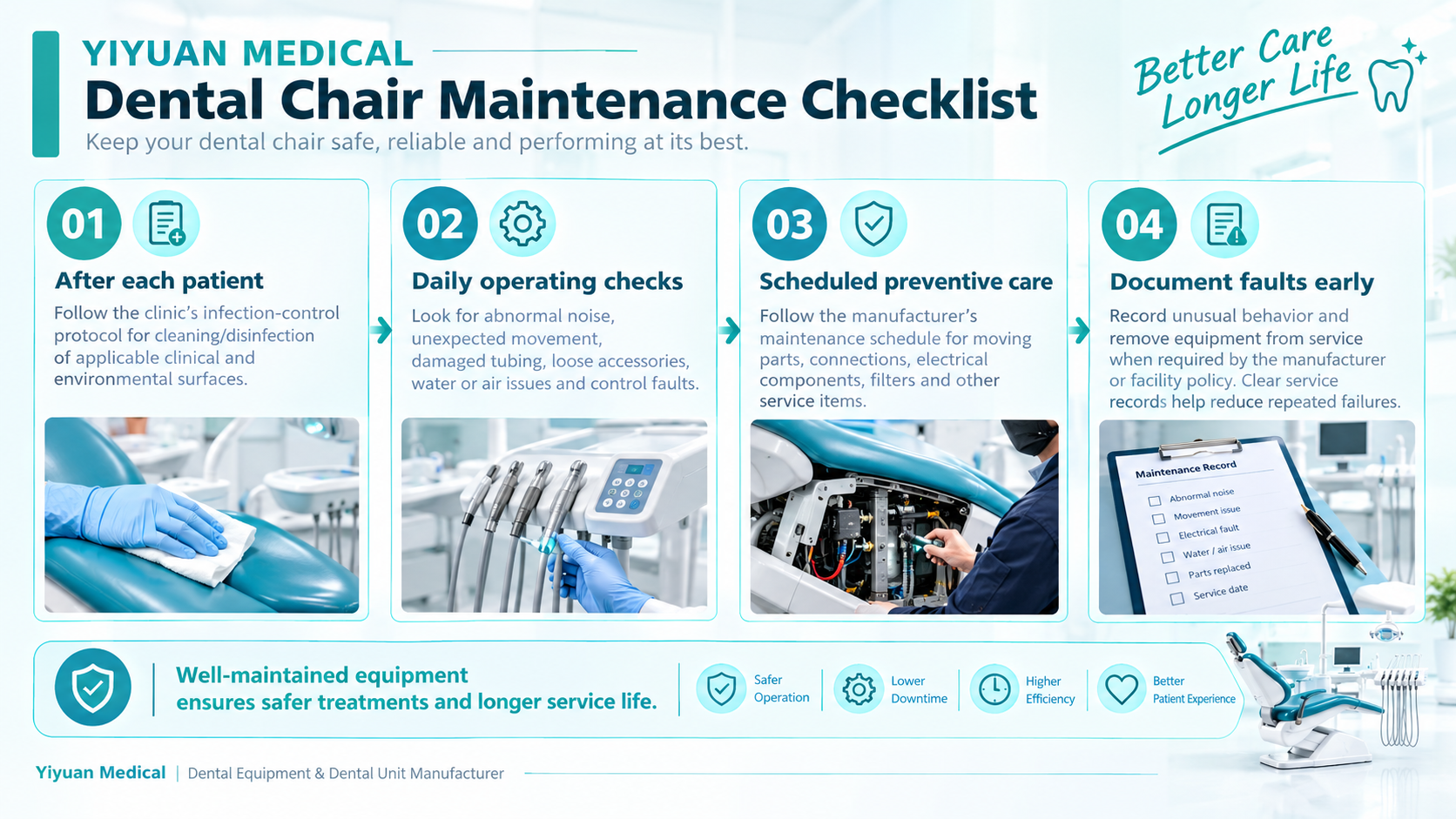
Maintenance should be treated as part of clinical operations. The CDC’s dental infection-prevention guidance describes Standard Precautions as the minimum infection-prevention practices for patient care and includes clean and disinfected environmental surfaces and sterile instruments/devices. The CDC also recommends using its dental infection-prevention checklist and consulting the full guidance for detailed evidence and rationale.
Follow the product manufacturer’s instructions and the clinic’s validated infection-control procedure for chair surfaces, handles, controls and other areas that may be exposed during care. Select compatible disinfectants; aggressive chemicals or incorrect dwell times can damage materials. The goal is to control contamination while preserving the equipment surface and mechanical components.
Before or during routine operation, listen for abnormal sounds and check for smooth movement. Inspect visible tubing and cables, look for leaks, verify water and air functions, and check that trays, handles and accessories remain secure. Small abnormalities should be documented before they develop into a major failure.
Use the manufacturer’s technical documentation to determine inspection points and intervals. Depending on the design, this may include moving components, electrical connections, control systems, tubing, filters and other replaceable parts. Keep a record of service dates, replaced parts and observations.
Cleaning and disinfection procedures are driven by infection-prevention requirements and product compatibility; mechanical maintenance is driven by engineering and manufacturer instructions. These should not be conflated. A disinfectant procedure cannot replace preventive maintenance, and maintenance cannot replace clinical infection-control practices.
A useful checklist can have four columns: item, frequency, person responsible and result/action. Add a final field for service ticket or technician reference. This turns maintenance from a memory task into a repeatable workflow.
How often should a dental chair be maintained?
Use the manufacturer’s maintenance schedule and the clinic’s infection-prevention procedures. Daily functional checks and routine cleaning are different from planned mechanical maintenance.
Can disinfectants damage a dental chair?
They can if the product is incompatible or used incorrectly. Follow the chair and disinfectant manufacturer instructions.
Evidence & source note
|
Organization / evidence |
Original source address |
|
U.S. CDC |
|
|
U.S. CDC |
https://www.cdc.gov/dental-infection-control/hcp/summary/standard-precautions.html |
|
International Organization for Standardization (ISO) |